Product Description
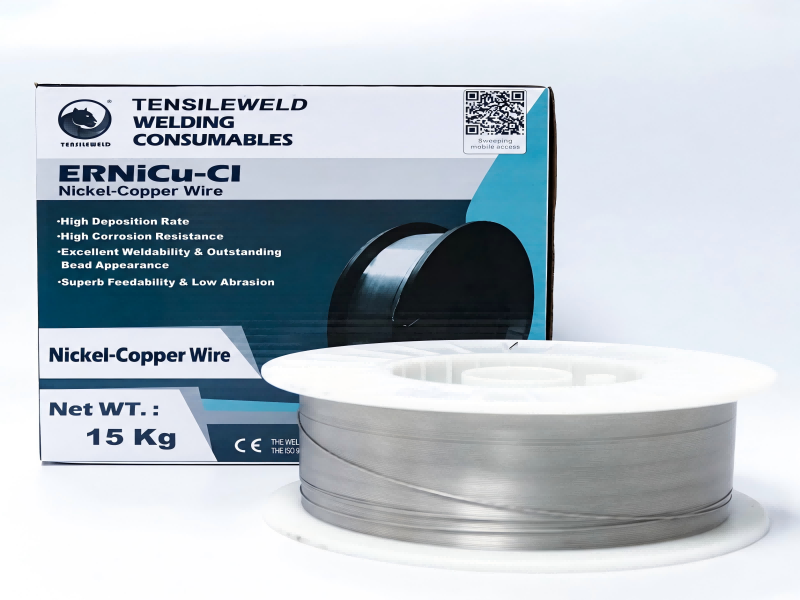
Grade: ERNiCu‑CI Nickel‑Copper Wire
ERNiCu‑CI nickel‑copper alloy solid wire is an economical‑grade MIG welding consumable specially developed for ordinary low‑load cast iron repair work. It features moderate crack‑resistance performance with higher deposited weld hardness. This cost‑effective welding wire is widely used for repairing sand holes, porosity and minor casting defects on non‑machined cast iron components like valve bodies and housings.
Important note: This product is NOT suitable for precision‑machined working surfaces or high‑load impact‑bearing positions.
Chemical Composition (Wt%)
| Element | Content |
|---|---|
| Ni | ≈60.0 |
| Cu | ≈35.0 |
| Fe | Balance |
| C | ≤0.05 |
| Si | ≤0.50 |
| Mn | ≤1.00 |
| S | ≤0.03 |
| P | ≤0.03 |
Mechanical Properties (Weld Deposit)
| Item | Result |
|---|---|
| Tensile Strength | ≥ 400 MPa |
| Elongation | ≥ 10 % |
Recommended Welding Parameter
| Parameter | Value |
|---|---|
| Welding Current | 90‑130 A |
| Arc Voltage | 18‑22 V |
| Shielding Gas | Pure Argon / Argon +5~10% CO₂ |
| Wire Feed Speed | 4.0‑6.0 m/min |
Features & Characteristics
✅ Economical grade with competitive lower price
✅ Moderate cracking‑resistant performance
⚠️ Weld deposit with relatively high hardness
⚠️ Poor machinability for precision finishing
✅ Moderate cracking‑resistant performance
⚠️ Weld deposit with relatively high hardness
⚠️ Poor machinability for precision finishing
Typical Application
- Repair for low‑load ordinary cast‑iron workpieces
- Repair sand holes, shrinkage cavities and minor casting defects
- Repair non‑machined surfaces of cast iron valves, gear housings and pump housings
- Restriction: Do not use on precision‑finished surfaces, high‑stress or impact‑loaded working locations
Welding Operation Guidelines
- Thoroughly clean the welding groove and remove dirt, oil, rust before welding.
- Use short‑circuit metal transfer mode, run welding at relatively low current.
- Adopt segmented intermittent welding. Hammer the weld bead after welding for stress relief.
- Preheat thick cast‑iron workpieces to 100‑200°C prior to welding.
- Do not apply this wire for components under high‑stress and impact service conditions.