Product Description
Product Overview
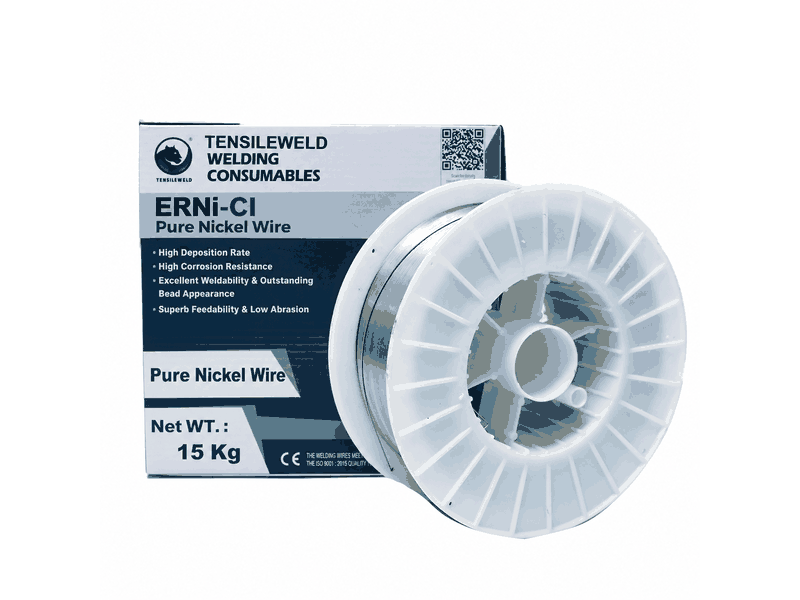
Grade: ERNi‑CI Pure Nickel Wire
ERNi‑CI pure nickel solid MIG welding wire is premium‑grade cast‑iron repair welding consumable. It delivers excellent ductility and outstanding crack‑resistance. Its thermal expansion coefficient is very close to cast‑iron material. The weld deposit can be machined precisely after welding, which makes it the preferred choice for repairing cast‑iron workpieces that require high‑precision post‑weld machining.
Note: Material cost is relatively high; tensile strength is slightly lower compared with other cast‑iron welding wires.
Chemical Composition (Wt%)
| Element | Content |
|---|---|
| Ni | ≥95.0 |
| Fe | Balance |
| C | ≤0.10 |
| Si | ≤0.10 |
| Mn | ≤0.30 |
| S | ≤0.015 |
| P | ≤0.015 |
Mechanical Properties (Weld Deposit)
| Item | Result |
|---|---|
| Tensile Strength | ≥420 MPa |
| Elongation | ≥18 % |
Recommended Welding Parameters
| Parameter | Value |
|---|---|
| Welding Current | 90‑130 A |
| Arc Voltage | 18‑22 V |
| Shielding Gas | Pure Argon / Argon +5~10% CO₂ |
| Wire Feed Speed | 4.0‑6.0 m/min |
Features & Characteristics
✅ Superior ductility and excellent crack‑resistant performance
✅ Thermal expansion close to cast‑iron base metal
✅ Outstanding machinability for high‑precision machining after repair
⚠️ Higher material cost
⚠️ Slightly lower tensile strength
✅ Thermal expansion close to cast‑iron base metal
✅ Outstanding machinability for high‑precision machining after repair
⚠️ Higher material cost
⚠️ Slightly lower tensile strength
Typical Applicatio
- Repair of thin‑wall grey cast‑iron components
- Precision machine guideway restoration
- Crack repairing for engine cylinder heads
- Dissimilar welding between cast iron and carbon steel
- All cast‑iron parts that require high‑precision machining after welding
Welding Operation Guidelines
- Completely remove oil, rust and paint within the welding zone before starting work.
- Use low heat‑input welding technique, run narrow weld beads, adopt segmented back‑step welding method.
- Hammer every finished weld bead immediately to release residual welding stress.
- For thin workpieces: no preheating is required. For thick workpieces: preheat to 100‑250℃.
- Allow the welded component to cool down slowly after welding.